Updated August 2026. This post is part of our monthly column on the cost of the official API. We review the numbers every month against Meta’s official source.
The official WhatsApp API has no monthly fee charged by Meta. You pay per delivered template message, at a price that depends on the category (marketing, utility or authentication). This per-delivered-message model has been in force since July 1, 2025. Replies inside the 24-hour customer service window remain free until October 1, 2026. What moves your bill at the end of the month is the mix: how many templates you send, and in which category.
In this guide you will see how per-message billing works, the rates for Brazil, the extra costs nobody counts and a practical simulation to estimate your real spend.
Quick summary
- Meta charges for the official API per delivered template message, no longer per 24-hour conversation. The model has been in force since July 1, 2025 (Meta’s official pricing page, consulted in August 2026)
- Rates in Brazil: marketing R$0.3217, utility R$0.0350 and authentication R$0.0350 per message (Meta’s official BRL rate card, CSV, effective since July 1, 2026)
- Since July 1, 2026, Meta can bill in Brazilian reais (BRL), per WABA account and by opt-in. Migration is mandatory by June 30, 2027, with an invoice issued by Facebook Brazil
- Replies inside the 24-hour window opened by the customer remain free until October 1, 2026, when service messages start being charged
- Total cost = Meta’s per-message rate + the plan of the automation platform (BSP) you use
complete guide to WhatsApp customer service automation
What changed in August 2026
Two changes define the August 2026 landscape. First: since July 1, 2025, Meta stopped charging per conversation (a 24-hour window at a fixed price per category). It now charges per delivered template message, a model confirmed on Meta’s official pricing page, consulted in August 2026. Second: since July 1, 2026, Meta can bill Brazilian accounts in reais (BRL), per WABA and by opt-in. Migration is mandatory by June 30, 2027, with the invoice issued by Facebook Brazil. Companies that migrate stop depending on dollar swings, which used to wreck cost forecasts.
In practice, this changes how you plan costs:
- Before: opening a marketing conversation cost a fixed amount, and you could send several messages inside it for the same price.
- Now: every delivered template is billed individually, even several inside the same window (Meta’s official pricing page, August 2026).
- Consequence: campaigns with heavy broadcasting became far more sensitive to volume. Businesses that reply well inside the 24-hour window spend less.
The news recorded in this August 2026 review: billing in reais available by opt-in, with rates published in Meta’s official BRL rate card (CSV, effective since July 1, 2026): marketing R$0.3217, utility R$0.0350, authentication R$0.0350 per message.
What the official WhatsApp API is
The official API (WhatsApp Business Platform) is the entry point authorized by Meta for companies that need automation, multiple agents and sending at scale. API stands for “application programming interface”: it is the technical channel that connects WhatsApp to customer service and automation platforms.
It is different from the free WhatsApp Business app, which works well for a solo operator on a phone. And it is different from unofficial APIs, which run outside Meta’s rules and put your number at risk of being banned.
official vs unofficial WhatsApp API: differences and risks
With the official API you get eligibility for the verification badge, stability, approved template sending and integration with automation and AI. There is a cost, but it is predictable and auditable, as you will see next.
How per-template-message billing works
Meta charges per delivered template message, not per sent message, and the price depends on the template category. If the message does not reach the recipient, you do not pay. The model has been in force since July 1, 2025 (Meta’s official pricing page). The categories are:
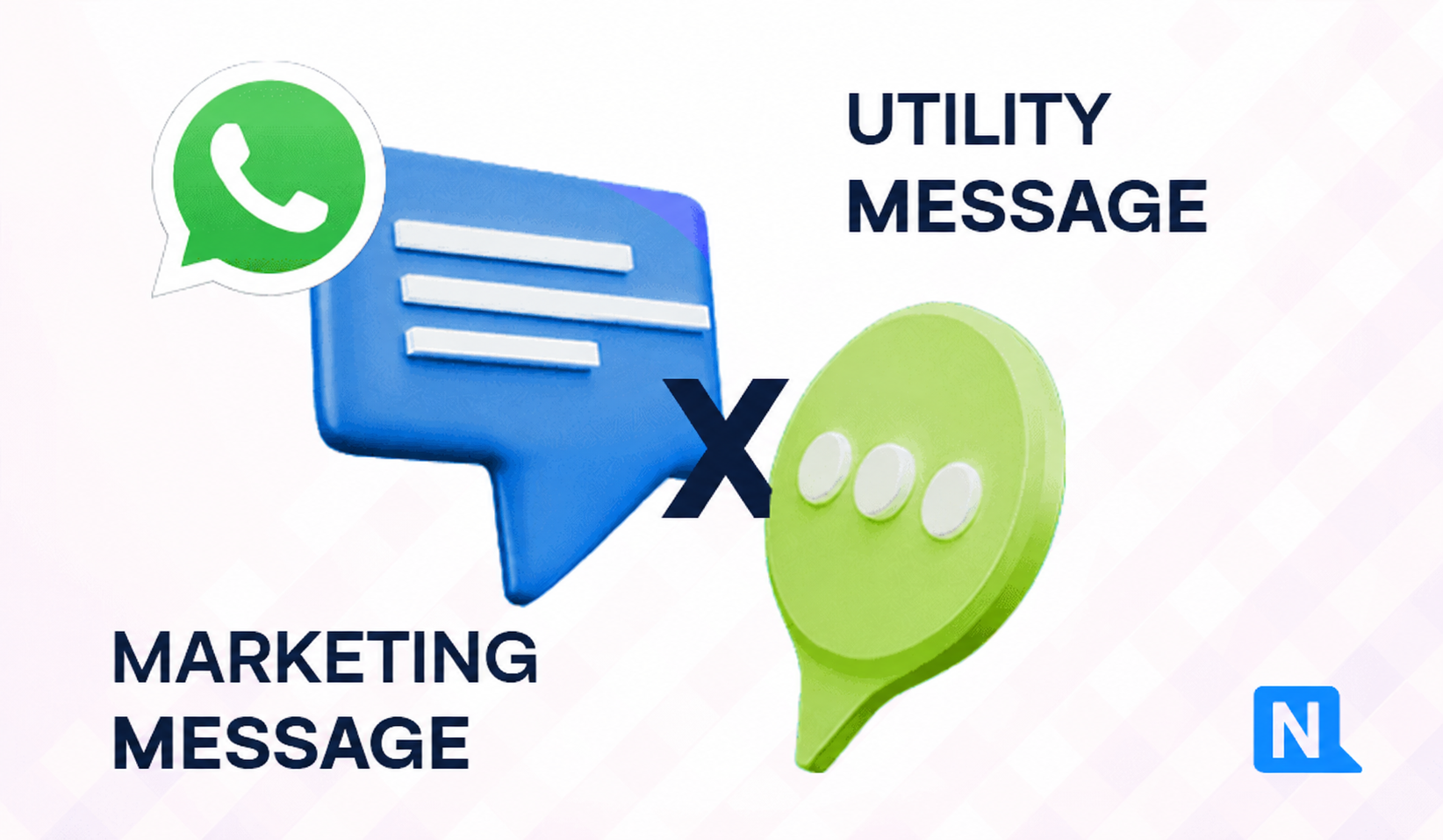
- Marketing: promotions, offers, launches, cart recovery with a coupon. The most expensive category: R$0.3217 per message in Brazil (Meta’s official BRL rate card, CSV, effective since July 1, 2026).
- Utility: order updates, confirmations, appointment reminders, payment notices. R$0.0350 per message, roughly 9 times cheaper than marketing.
- Authentication: verification codes (OTP). Also R$0.0350 per message, tied with utility as the lowest paid rate.
And what does Meta not charge for?
- Replies inside the 24-hour window: when the customer sends a message, a customer service window opens. Free-form messages (no template) inside that window are free until October 1, 2026, when service billing begins.
- Utility templates inside an open window: still free, according to Meta’s official pricing page (August 2026).
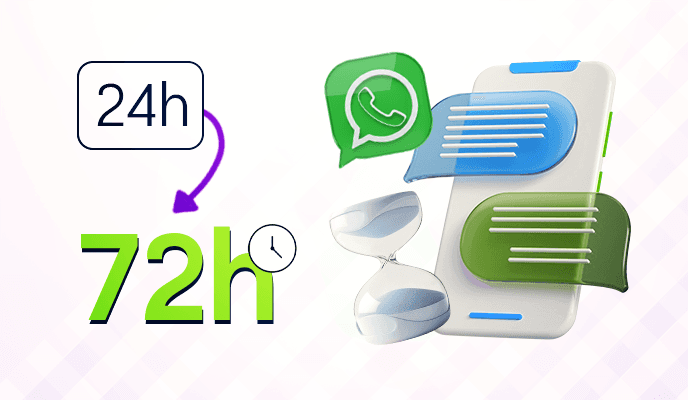
- Free Entry Point: click-to-WhatsApp ads and the WhatsApp button on a Facebook Page open a 72-hour window. Inside it, any message is free. It is the only 72-hour window that exists. Note: the cost is zero for those 72 hours, but free-form text still requires an open 24-hour customer service window. Without it, templates only, free until the Free Entry Point expires: “if the customer service window closes, you will only be able to send template messages” (Meta pricing documentation, consulted in August 2026).
the 24-hour WhatsApp customer service window: how it works
Meta classifies the template at approval time. A template written as “utility” but carrying promotional content can be reclassified as marketing, and the cost changes with it.
marketing vs utility messages: how to classify and pay less
Official API price table for Brazil (August 2026)
The figures below come from Meta’s official BRL rate card (CSV, effective since July 1, 2026), downloaded from the official pricing page. Meta publishes prices per country and per category, and in Brazil it now bills directly in reais (BRL), with no dollar conversion. These are the Brazilian rates: Meta prices every country separately, so if your customers are in another market you need to check that country’s rate card.
| Message category | When to use it | Price per message (Brazil) |
|---|---|---|
| Marketing | Offers, promotions, remarketing | R$0.3217 |
| Utility | Confirmations, notices, reminders | R$0.0350 |
| Authentication | Verification codes (OTP) | R$0.0350 |
| Reply inside the 24h window | Answering an incoming message | R$0 (free until October 1, 2026) |
Source: Meta’s official BRL rate card (CSV, effective since July 1, 2026). How to download it: Meta’s pricing page → “Rate cards” section → download the BRL file. The figures change without notice; always confirm at the source before signing off on a budget.
Extra costs beyond Meta’s rate
The per-message rate is only part of the bill. To actually run the official API, factor in:
Automation platform (BSP or integrated solution). The API has no interface of its own. You need a platform to build flows, serve customers with a team and run campaigns. NicoChat plans start at US$29/month on Starter (500 contacts) and US$39/month on PRO (1,000 contacts). These are August 2026 reference figures; check the current ones at nicochat.com/en/pricing.
BSP fee per message. Some providers add a markup on top of Meta’s rate. Always ask whether the cost is passed through directly or with a margin.
Business verification. Meta does not charge for business verification, but it does demand consistent documentation. What gets checked: legal name, address, phone, email and company website, always against the documents you submit. In Brazil that usually means the CNPJ registration or articles of incorporation to prove the legal name, plus a recent utility bill or bank statement for address and phone. The most common reason for rejection is a mismatch between what you type into Business Manager and what the document says: an abbreviated name, an outdated address, a phone number from another branch. The review can come back in minutes or take up to about two weeks.
Content and operations cost. Writing templates, segmenting contacts and keeping the list clean takes someone’s time. It does not show up on Meta’s invoice, but it exists.
Practical simulation: how much per month
Let’s simulate a store serving 1,000 customers a month, using the figures from Meta’s official BRL rate card (CSV, effective since July 1, 2026). Because that rate card is country-specific, this simulation is a Brazil scenario.
Scenario: a clothing store with active customer service and one monthly campaign.
- 600 conversations started by customers (questions, orders): answered inside the 24-hour window. Meta cost: R$0 (free until October 1, 2026).
- 1,000 marketing templates delivered (launch campaign): 1,000 × R$0.3217 = R$321.70.
- 800 utility templates delivered (order confirmation and status): 800 × R$0.0350 = R$28.00.
- Automation platform plan: NicoChat PRO, US$39/month for 1,000 contacts (R$197 at the site’s reference rate). August 2026 reference figure; check the current ones at nicochat.com/en/pricing.
Estimated month total: R$321.70 + R$28.00 = R$349.70 in Meta rates, plus the reference NicoChat PRO plan at US$39 (R$197), for a combined R$546.70. For comparison: if the whole list received only utility messages, 1,000 messages × R$0.0350 would come to R$35.00. The same 1,000 messages as marketing cost R$321.70, almost 9.2 times more.
The pattern that matters: under per-message billing, cost grows in a straight line with marketing send volume. Cutting bad sends is the number one savings lever.
How to save on the official API
Five practices that shrink the bill without shrinking your service:
- Reply inside the 24-hour window. Every reply inside the window the customer opened avoids a paid template. AI automation answers instantly, including at 3 a.m.
- Classify templates honestly and strategically. An order notice is utility, not marketing. In Brazil, marketing costs R$0.3217 and utility R$0.0350: a gap of almost 9.2 times that multiplies with volume (Meta’s official BRL rate card, CSV, effective since July 1, 2026).
- Segment before you send. Blasting a cold list is expensive and drags down your number quality rating. Send to people who engage.
- Use the exempt entry points. Click-to-WhatsApp ads and the Facebook Page button open a 72-hour window. Inside it, any message is free (Meta’s official pricing page, August 2026). The exemption zeroes the cost, but free-form text still needs a 24-hour window open since the customer’s last reply. Customer gone quiet? Send a template, free inside the Free Entry Point: “if the customer service window closes, you will only be able to send template messages” (Meta pricing documentation, August 2026).
- Measure cost per converted conversation. Don’t look at the invoice alone. A marketing campaign that converts pays for its own rate.
Frequently asked questions about official API costs
Do I need a registered company to use the official API?
Yes. For full operation Meta requires business verification, and in Brazil that goes through a CNPJ and consistent company data. Without verification you are not shut out, but you stay small: new portfolios start limited to 250 unique customers per 24-hour period, and verifying the business is one path to the 2,000 tier. The tiers after that (10,000, 100,000 and unlimited) become automatic, based on your number quality and the volume you already use (Meta’s messaging limits documentation, consulted in August 2026).
Can I test the official API for free?
Meta charges no monthly fee, so the cost of testing comes down to the templates you deliver. Replies inside the 24-hour window remain free until October 1, 2026. On the platform side, NicoChat has a 7-day free trial with no credit card, which lets you build the flow before paying for any plan.
Can I contract directly with Meta, without a platform?
Technically yes, through the Cloud API, but you get the raw API only: no service inbox, no flow builder, no team management. For anyone without a development team, an integrated platform costs less than building everything from scratch.
What is the 24-hour customer service window?
It is the period that opens when the customer messages the company. Inside it, you reply with free-form messages, no template and no Meta charge, until October 1, 2026. Outside it, the only way to start contact is with an approved, paid template.
the 24-hour and 72-hour windows explained in detail
Can I send a marketing message inside the 24-hour window?
You can, but the marketing template is billed as usual, even with the window open. Every delivered template is charged individually, and the in-window exemption applies to utility only. Free-form messages with commercial content inside the window, such as answering a question about price, do not use a template.
Do I need to know how to code to use the official API?
No. The technical layer sits with the platform. In NicoChat, you connect your official number and build flows, campaigns and AI agents in a visual interface, with no code.
Conclusion: the cost is predictable once you understand the model
In August 2026, the cost of the official WhatsApp API comes down to one equation: delivered templates × the category rate + the platform plan. In Brazil, that means R$0.3217 per marketing message and R$0.0350 per utility or authentication message. Billing in reais has been available by opt-in since July 2026 and will be mandatory by June 30, 2027. Whoever masters the 24-hour window and classifies templates properly pays the minimum possible. You can confirm the exact figures in Meta’s official BRL rate card (CSV, effective since July 1, 2026), published on Meta’s pricing page, and this column comes back every month with what changed.
Want to estimate your real cost with a live flow? Create your NicoChat account, connect the official API and build your first automated conversation: 7-day free trial, no credit card.
complete guide to WhatsApp customer service automation for small businesses