Updated in August 2026
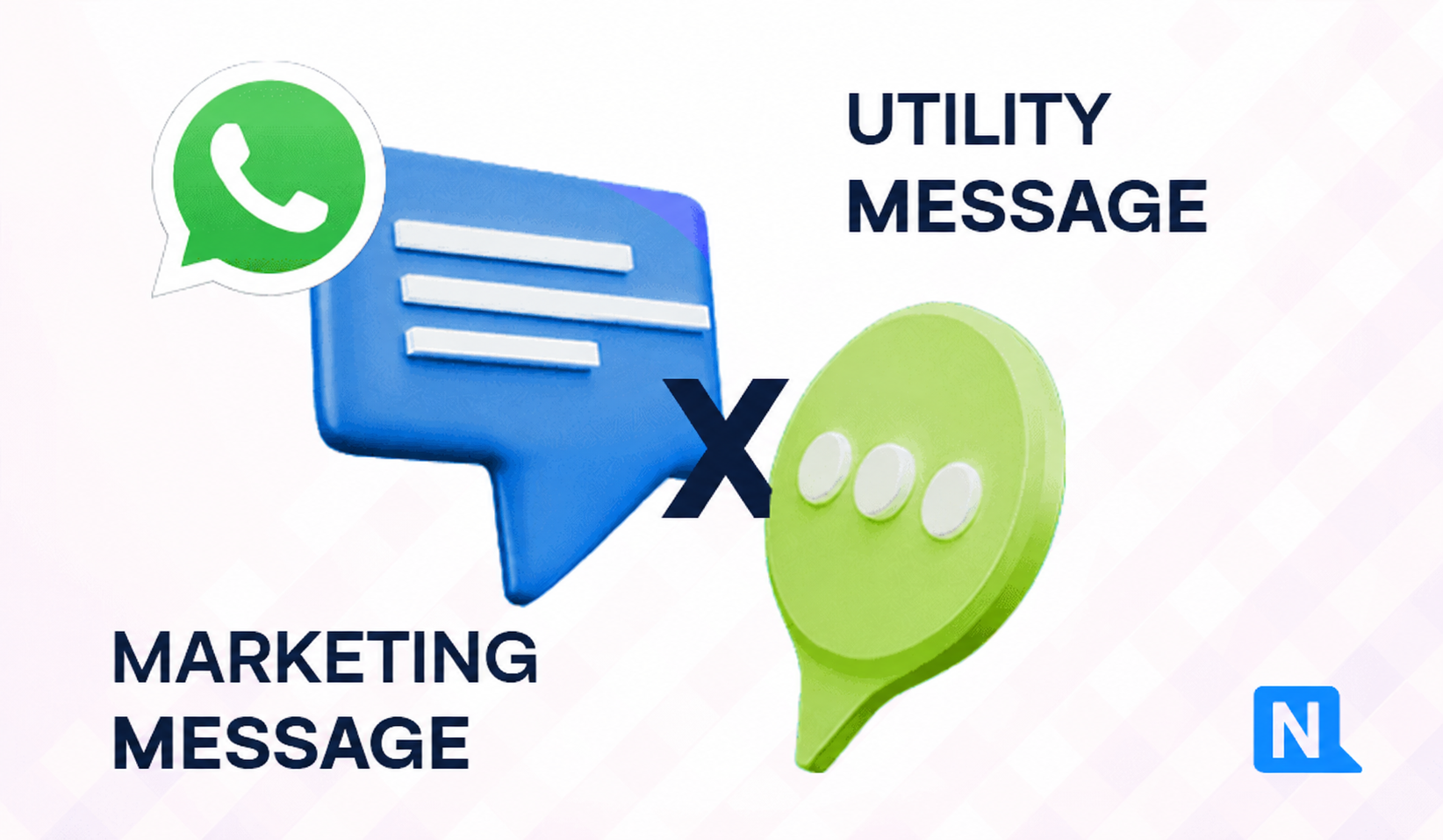
A utility message is one that continues an action the customer already started: an order confirmation, a delivery notice, a payment reminder. A marketing message is one that promotes something new: an offer, a launch, a coupon, an invitation to buy. The difference looks like a detail, but it decides how much you pay per delivered message on the official WhatsApp API. It also decides whether Meta approves (or reclassifies) your templates.
In this guide you will see how Meta categorizes each type today, practical examples of real messages from small and medium businesses (SMBs), and a step-by-step method for classifying yours without mistakes.
complete guide to WhatsApp customer service automation
Quick summary
- Meta divides official WhatsApp API templates into 3 categories: marketing, utility and authentication (Meta pricing page, accessed in August 2026).
- Utility = the continuation of a transaction or order the customer started (e.g. “your order has shipped”). Marketing = any promotion, offer or invitation to buy.
- The category sets the price per delivered message. In Brazil: marketing R$0.3217; utility and authentication, R$0.0350 (Meta’s official BRL rate card, CSV, in effect since July 1, 2026). Rates differ by country.
- Meta has the last word on classification: a template with mixed content (notice + promotion) is categorized as marketing and billed as marketing. This reclassification rule has applied since April 2025 and can be appealed within 60 days.
What has changed since the previous version of this guide
This post was rewritten because Meta’s category structure and billing model have changed since the original publication. The main points:
- Current categories: the classification in force works with marketing, utility and authentication (Meta pricing page, August 2026).
- Billing model: since July 1, 2025, Meta charges per template message delivered, no longer per 24-hour conversation (Meta’s official pricing page).
- Stricter classification rules: since April 2025, Meta can reclassify utility templates with promotional content at approval time. The decision can be appealed within 60 days.
- We removed the old angle from the title: the previous version suggested “asking ChatGPT” what the difference was. The reliable answer is in Meta’s documentation, and that is what this guide summarizes.
Every value and specific rule cited here should be checked against the primary source on the date you read it. Meta’s rules change often.
What a utility message is on WhatsApp
A utility message is a template that follows up on an action, order or agreement the customer already started with you. It exists to inform, not to sell. Meta defines utility as messages related to a specific transaction, account, order or customer request (Meta’s template categorization page, accessed in August 2026).
In practice, these are messages the customer expects to receive. They bought, booked or requested something. Your business is simply telling them what happened next.
Examples of utility messages from an SMB:
- Online store: “Your order #482 has shipped. Tracking code: BR123456789.”
- Clinic: “Reminder: your appointment with Dr. Paula is tomorrow at 2 p.m. Reply 1 to confirm.”
- Subscription service: “Your August invoice is due in 3 days. Duplicate copy at the link below.”
- Repair shop: “Your device is ready for pickup at our downtown store.”
Notice the pattern: in every case there is a prior transaction started by the customer. Without that transaction, the message does not hold up as utility.
What a marketing message is on WhatsApp
A marketing message is any template that promotes a product, service, offer or brand, or that tries to generate a new sale. If the goal is to make the customer buy something they have not asked for yet, it is marketing. It does not matter how “useful” the offer looks to you.
Examples of marketing messages from an SMB:
- Clothing store: “The new winter collection is here! Take 20% off through Sunday.”
- Restaurant: “Tuesday is double all-you-can-eat night. Book your table.”
- Online course: “Last spots for the August cohort.”
- E-commerce: “You left items in your cart. Check out now and get free shipping.”
That last example tends to raise doubts. Cart recovery looks like the continuation of a customer action, right? Meta tends to classify abandoned cart messages as marketing, because they are promotional content. The factual recovery of an open quote or order may qualify as utility. The final category is decided by Meta at template approval [VERIFY: Meta’s template categorization page on the publication date].
What about authentication messages?
Authentication is the third category: templates that send one-time codes for login, account verification or access recovery. Example: “Your verification code is 483920. Do not share it with anyone.”
For most SMBs that use WhatsApp to serve customers and sell, this category rarely comes up. It matters for businesses with an app or a logged-in area that use WhatsApp to send codes instead of SMS. Meta enforces a fixed format for these templates, with little freedom in the text [VERIFY: authentication template format requirements at developers.facebook.com].
What each category costs (and why that matters)
The template category sets the rate Meta charges per delivered message, and each delivered template is billed individually. Marketing has the highest rate in Brazil: R$0.3217 per delivered message. Utility and authentication cost R$0.0350 each, according to Meta’s official BRL rate card (CSV, in effect since July 1, 2026). These figures are the Brazilian rate card; Meta publishes different rates for each country, so check the one that applies to the market you send to.
Two points make a real difference on your bill at the end of the month:
- Volume amplifies the gap. If you send thousands of messages a month, classifying wrong (paying the marketing rate on a message that could have been utility) multiplies your cost for no reason.
- Messages inside the service window are treated differently. Utility templates delivered inside the window opened by the customer are free (Meta’s official pricing page, August 2026). Marketing templates are charged even with the window open. Free-form replies, without a template, remain free until October 1, 2026.
| Category | What it is | Example | Rate per delivered message (Brazil) |
|---|---|---|---|
| Marketing | Promotes a product, offer or brand and seeks to generate a new sale | "The new winter collection is here! 20% off through Sunday." | R$0.3217 |
| Utility | Follows up on a transaction, order or account the customer started | "Your order #482 has shipped. Tracking: BR123456789." | R$0.0350 |
| Authentication | Sends a one-time code for login or account verification | "Your verification code is 483920." | R$0.0350 |
Source: Meta’s official BRL rate card (CSV, in effect since July 1, 2026). Rates shown apply to Brazil.
To understand the figures and simulate your monthly cost, see the dedicated pricing guide.
how much the official WhatsApp API costs
And to understand when you need a paid template and when you can reply for free, the key concept is the 24-hour window.
how the 24-hour WhatsApp service window works
How to classify your messages: step by step
Use this sequence of questions before you create each template. It resolves most cases.
1. Does the message send an access code?
If yes, it is authentication. End of analysis.
2. Is there a transaction or order the customer already started?
Ask yourself: “does this message only make sense because the customer bought, booked or requested something first?” If yes, you have a utility candidate. If the message would make sense sent to any contact in your list, it is marketing.
3. Does the message contain any promotional element?
This is where the most common mistake lives. A utility template with one promotional sentence at the end stops being utility. “Your order has shipped. While you’re at it, check out our new collection!” mixes the two, and Meta treats the whole thing as marketing (Meta’s template categorization page, August 2026).
Practical rule: if you want to notify AND promote, create two separate templates. The notice goes out as utility, the promotion as marketing. You pay the higher rate only on the message that actually promotes.
4. When in doubt, assume marketing
If after the questions above the classification is still ambiguous, classify it as marketing. It is better to pay the higher rate on one template than to have templates reclassified or rejected, which delays your campaigns.
Practical examples: classify along with us
Test the logic with real cases. The answer comes right below each one.
“Your order is out for delivery and arrives today by 6 p.m.” Utility. The direct continuation of a purchase made by the customer.
“We have a special birthday deal for you: 15% off this week.” Marketing. An offer, with no related prior transaction.
“Your appointment has been moved to Thursday at 10 a.m. Reply 1 to confirm.” Utility. An update to an existing booking.
“Your plan expires tomorrow. Renew now and get a free month.” Marketing. The expiration notice on its own would be utility, but the “free month” creates mixed content. Under Meta’s rule, mixed content is categorized as marketing.
“Your login code is 774213.” Authentication.
“We noticed you didn’t complete your purchase. Your items are still reserved.” Marketing, based on Meta’s classification tendency for abandoned carts. The same caveat from the marketing section applies: the final category is decided by Meta at template approval.
Meta has the final word
You propose the category when you create the template, but Meta reviews it and can reclassify it at approval. The rule has applied since April 2025 (Meta’s template categorization page). If you disagree with a reclassification, you can appeal within 60 days.
In practice, that means three precautions:
- Do not try to “disguise” marketing as utility. The reclassification is automatic and you pay the marketing rate anyway.
- Review old templates. If your templates were created before the rule changes, their categories may have been reclassified. Check in the WhatsApp Business manager.
- Follow Meta’s announcements. Price and policy changes are announced in advance on the official pages (business.whatsapp.com and developers.facebook.com).
Frequently asked questions
Are WhatsApp utility messages free?
It depends on when they are delivered. Outside the service window, a utility template is charged at the category rate. Inside the 24-hour window opened by the customer, it is free (Meta’s official pricing page, August 2026). The short, safe answer: utility is not a synonym for free, but it is the cheapest paid category.
Can I send a promotion to someone who messaged me on WhatsApp?
You can, as long as the person has agreed to receive that kind of message (opt-in) and the template is classified as marketing. Sending promotions without consent violates Meta’s policy and increases the risk of your number being blocked [VERIFY: opt-in requirements in force under Meta’s messaging policy].
What happens if I classify wrong?
Meta reclassifies the template into the correct category, and billing follows the final category, not the one you declared. Reclassification happens at approval, under the rule in force since April 2025. If you disagree, you can appeal the decision within 60 days.
Does this apply to the free WhatsApp Business app?
No. Categories and rates apply to the official API (WhatsApp Business Platform), used with automation platforms. The free WhatsApp Business app does not charge per message, but it also does not allow automation at scale or multiple agents on the same number.
official vs unofficial WhatsApp API
Conclusion: classify correctly and pay less
The rule that solves 90% of cases fits in one sentence: if the message continues something the customer started, it is utility; if it invites them to something new, it is marketing. Separate notices from promotions into different templates, check the current rates on Meta’s official page before sending at volume, and review old templates that may have been reclassified.
The natural next step is putting that classification to work: building the right templates, sending them in the right category and replying inside the window to pay less. You can do all of it without coding. Create your NicoChat account and try it free for 7 days, no credit card.